

Last night I got a bunch of emails and WhatsApp messages from readers and subscribers who dug the special edition on Yohanan and Resh Lakish and asked for more special editions! First of all, thank you all for following along. This is a long-term project, it’s pretty labor intensive and certainly a niche endeavor, and that some folks find value in it means a lot. There’s another intense, human interest one coming your way in a few weeks, but I think today’s page is nothing to shake a stick at, as it’s going to delve into King David’s worst moral failing.
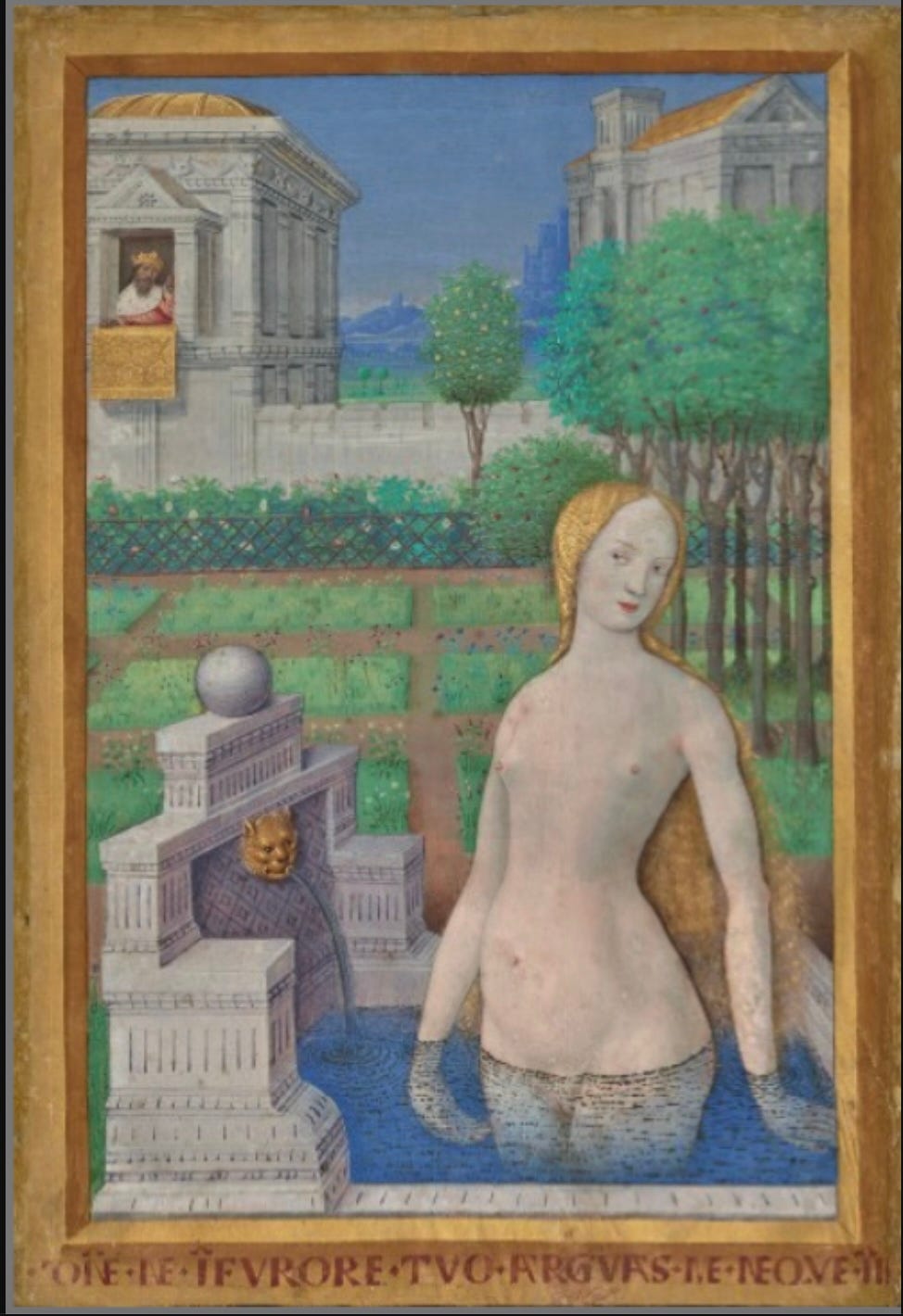
Quick biblical recap: David’s army, commanded by Yoav, lays siege to the city of Rabbah. In the evening, David, who stayed behind in Jerusalem, rises from his bed and walks on the roof, when he notices a very beautiful woman (טוֹבַ֥ת מַרְאֶ֖ה מְאֹֽד) bathing, presumably at a nearby home. He asks about her, and receives a report that the woman is Bathsheba, daughter of Eliam, and she is married to Uriah the Hittite. David sent for her; she was brought to the palace and they lay together (the text punctiliously tells us that she just happened to have purified herself after her period) and she went back home. But consequences knocked on David’s door when Bathsheba informed him that she was pregnant.
David’s first thinking is a coverup: if she sleeps with her husband, no one will ever be the wiser. So he asks Yoav to let Uriah, who is among the soldiers, take a break at home. Uriah is called before David, who asks him how the war effort is going and implores him to wash up and go home. There, that problem’s taken care of, thinks the duplicitous king, and imagine his dismay when the next morning he learns that Uriah didn’t actually go home. To complicate things further, Uriah turns out to be an incredibly decent man, a model of solidarity who would not sleep in comfort and make love to his wife while his comrades face battle, which makes him a poignant foil to the king. At this point, though, David is so invested in hiding his misdeed that he keeps Uriah in Jerusalem, invites him over to drink, ensure that he imbibes a lot, and sends him home. Perhaps now that he’s so drunk he’ll fancy a little tumble in the sack and I’ll be safe, thinks the king. But no! Uriah remains humble and decent even when drunk.
This leads David to the ultimate treachery: he writes Yoav, asking him to place Uriah at the battlefront and fall back, so that he will be slain in battle. Yoav follows suit (this will be his own sin to atone for) and indeed, the battle unfolds badly for the Israelites: the people of Rabbah fought hard and there were casualties. Yoav informs David of the battle, specifically mentioning Uriah’s death. David, who clearly can only think about one thing, encourages Yoav to keep fighting and ruin the city, and on the sly, waits until the mourning period is over and then fetches Bathsheba to the royal palace.
The sin is dramatically revealed by Nathan the prophet using the famous parallel about the lamb of the poor. David’s contrition (notably, only after he is told that the greedy rich man from the parable is him) saves him from death, but costs him the life of his and Bathsheba’s son, for whom he fasts and prays desperately to no avail. Later, Batsheba and David welcome a new baby: Solomon.
David’s story poses a challenge to the rabbinic engagement with the afterlife. We just read several pages that discussed various biblical characters and their downfall, with a special emphasis on bad kings. David is often portrayed as a legendary king, the dynastic father, the progenitor of the future messianic seed, etc., and yet this story is absolutely appalling. Not only does David emerge from this story as a lecher, unable to control his urges, but also a cheat and a coward, and it’s not even all on the personal level: we have ample daily proof of how selfish monarchs who sacrifice others to their utmost priority, covering their own asses, can lose legitimacy and tank morale in wartime. Which raises the question of our sugiyah: does such a king get an afterlife?
To absolve David, at least partly, we get a series of stories and interventions. Rav Yehuda cites Rav as saying that David, who noticed that he is not mentioned among the patriarchs, asked God to fashion a trial for him like those that Abraham, Isaac, and Jacob faced. God agreed, and even told him that he is giving him a warning ahead of time that it will be a sexual matter. It was for this reason that David is told to have risen “in the evening”: he tried to sleep with his wives during the daytime so he wouldn’t be tempted. But it was countereffective, because—and here comes the zinger—אֵבֶר קָטָן יֵשׁ בָּאָדָם, מַשְׂבִּיעוֹ – רָעֵב, וּמַרְעִיבוֹ – שָׂבֵעַ: man has a little organ. If he feeds him to satiety, it gets hungry; if he starves it, it becomes satiated.
It wasn’t just the proclivity of the little organ, though, that sabotaged our righteous king: Bathsheba was bathing behind a beehive, so David couldn’t see her, but Satan, in a rare cameo appearance outside of the context of the Book of Job, intervened. He took the form of a bird, and when David shot an arrow at the bird, he hit and broke the beehive, which exposed Bathsheba to his view.
We are then told that David was contrite and fasted for so long that he stopped bleeding; that Bathsheba was his rightful mate, except he took her a bit too soon; that, according to the prior pages dealing with executions, adulterers actually do get an afterlife; that he did what our friends at AA call a “fearless moral inventory” and asked for forgiveness for various unseen sins; and that God punished him with leprosy for six months.
There’s one more amazing story, in which God tells David that he’s looking into his request for forgiveness and, while he won’t let David know in life, he will announce the outcome during Solomon’s days. After David’s death, when Solomon inaugurated the temple and wanted to bring the ark in, the gates clung together and would not open, even though Solomon sang twenty-four songs and prayed. It was only when he said, “recall the favors of your servant David” that the gates opened, and then people knew that David was posthumously forgiven.
To make the point that repentance is possible, our sugiyah then pivots to the prophet Elisha and his sinning attendant Gehazi. We are instructed: לְעוֹלָם תְּהֵא שְׂמֹאל דּוֹחָה וְיָמִין מְקָרֶבֶת - in the context of sinners, push them away with your left hand but draw them in with your right. The two counterexamples are Elisha, who pushed Gehazi away and infected him with leprosy, and Yehoshua ben Perahya, who pushed Jesus (who was his student) away, driving him to, well, found a new religion.
That’s enough for today, save for mentioning that retellings of the David story have not been as quick as the rabbis to excuse and forgive. An especially dramatic retelling is one of my favorite Sherlock Holmest stories, The Crooked Man, which references the biblical source. And you can find echoes of this trope all over the film noir genre, where the David analogs end very poorly even as they express deep contrition, especially in James Cain’s The Postman Always Rings Twice and Tay Garnett’s film based on the novel, and, of course, Billy Wilder’s classic Double Indemnity.