

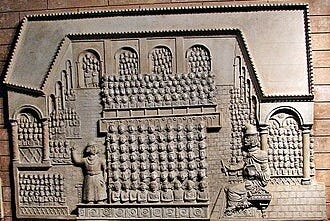
These days, most of us take for granted that the Babylonian Talmud is the central text of rabbinic Judaism; the daf yomi schedule we follow, which is observed throughout the Jewish world, pretty much dictates the agenda in every Orthodox yeshiva. But how did the Talmud come to occupy this sort of prominence? When did the people who lived after it was finished start to ascribe it the importance it has today?
Recently, in my Codes class with Dr. Alyssa Gray, we were assigned a few readings on the Geonic period, which have given me a richer perspective on this question. These included Christine Hayes and Jay M. Harris’ terrific edited volume What Is the Talmud? The State of the Question, and particularly Robert Brody’s chapter about the Geonim. We also read Robert Brody’s book The Geonim of Babylonia and the Shaping of Medieval Jewish Culture, which has more detail. The former book came out in 2026, so it really is the last word on the subject.
It turns out that we still do not have a clear date for a “final redaction” of the Talmud. Rather, what we know comes to us from Sherira Gaon’s Epistle, which you can find in full on Sefaria. Writing in 987, Sherira dates the end of hora’ah (the Amoraic period) to Rabina’s death in 499/500 CE. The epistle credits a generation of sages that followed Rabina, the Savora’im, with resolving the remaining open questions and with formulating some passages from scratch, such as the anonymous opening of Tractate Kiddushin. Brody concludes that the Talmud as it left the Savora’im was “clearly not identical” with what they inherited from the Amora’im. However, he rejects the radical view that virtually all anonymous material is Savoraic, arguing that many anonymous statements can be shown to be Amoraic.
Anyway, Sherira’s chronology implies the Savora’im operated for less than a century, and they were followed by the geonim; by his count, the geonic period began by about 588/9 CE. Some Suran sources may imply a later break, but Brody regards those as unreliable. But not everyone agrees with Sherira’s timeline: Gideon Libson, for example, notes that scholars place the Savoraic/geonic line anywhere from the late sixth to the mid-eighth century. At this point, whatever the Savora’im added to the Talmud became so embedded in the text that the Geonim regarded their contributions as an integral part of the Talmud itself.
It’s evident from Sherira’s Epistle that the Geonim, unlike the Savora’im, saw the Talmud as a closed corpus. They saw their role as transmitting and explaining it. But they were not working out of a unified written version. According to Brody, during the Geonic period the Talmud went from being orally transmitted to being transmitted in writing, but the two modes coexisted for a long time, and the famous academies in which the Geonim taught stayed oral to the end. It’s important to keep in mind that these academies were located in the same areas where the Babylonian Amoraim operated—throughout what had been the Sasanian empire, and was now Muslim territory—and so the Geonim had the advantage of geographic continuity and mastery of Aramaic (though they increasingly wrote in Arabic). Brody gives two examples, one from Shrira’s Epistle and one from a document by Aaron Sarjado (a Gaon from Pumbedita) that said that the rabbis relied on their memories, rather than on books. Brody also deduces that it was not rare for there to be small changes from version to version, and as opposed to the medieval commenters in Europe, who would already be treating every letter in the Talmud as consequential, the Geonim accepted inaccuracies and differences. When written versions did show up, the Geonim treated them with suspicion.
So when was it that we started treating the written Talmud with the reverence it receives now? The earliest reports, according to Brody, are from Spain. Natronai b. Hakhinai reportedly wrote out the Talmud from memory there around 770, and Paltoy Gaon reportedly had it written for the Spaniards in the mid-ninth century. The earliest surviving fragments date to about 900. Brody thinks writing arose to serve distant students who couldn’t attend the academies.
While the Geonim did not treat the Talmud as something that could be changed, they looked on it as an anthology, not a unified text. Aggadic components (stories, as opposed to rules) were not binding, and neither was dialectic arguments. For the Geonim, ultimate authority lay in the whole Babylonian tradition, including custom, and not in the Talmud alone. In practice, though, nearly every halakhic question was resolved by finding and interpreting the relevant talmudic passage. Brody credits the Geonim with making the Talmud the primary source of halakhic authority for all later rabbinic Judaism.
Thinking about how the Geonim understood and taught what was a revered but relatively recent collection goes a long way toward explaining how its status became what it is today. It explains the supremacy of the Babylonian over the Jerusalem Talmud and the idea that the text redaction had an end (that distinguishes between “writing it” and “commenting on it”), if foggy. It also explains why the Sephardi community had more respect for the Geonic commentary than the Ashkenazi community, which was removed from the creation of the text in space and time and viewed it more literally, in its written form, from a distance.