
Off the Table: b.Hullin 15
In which Rav silences an anonymous tanna

![[Still Life], Louis-Rémy Robert (French, 1810–1882), Paper negative](https://substackcdn.com/image/fetch/$s_!-S3y!,f_auto,q_auto:good,fl_progressive:steep/https%3A%2F%2Fsubstack-post-media.s3.amazonaws.com%2Fpublic%2Fimages%2F97b3ba8d-c09a-41ea-8a94-e69ea9f1b9f5_854x1200.jpeg "[Still Life], Louis-Rémy Robert (French, 1810–1882), Paper negative")
We are continuing our discussion of yesterday’s mishnah about eating meat that was slaughtered during Shabbat and Yom Kippur. A nameless tanna recites before Rav a rule we’ve already seen, which is that it all depends on the intent: if you accidentally cook food on Shabbat (how???) you may it it, but if you do so intentionally, you may not. We are then pithily told that Rav silenced that Tanna (וּמְשַׁתֵּיק לֵיהּ רַב), which of course made me think of this:
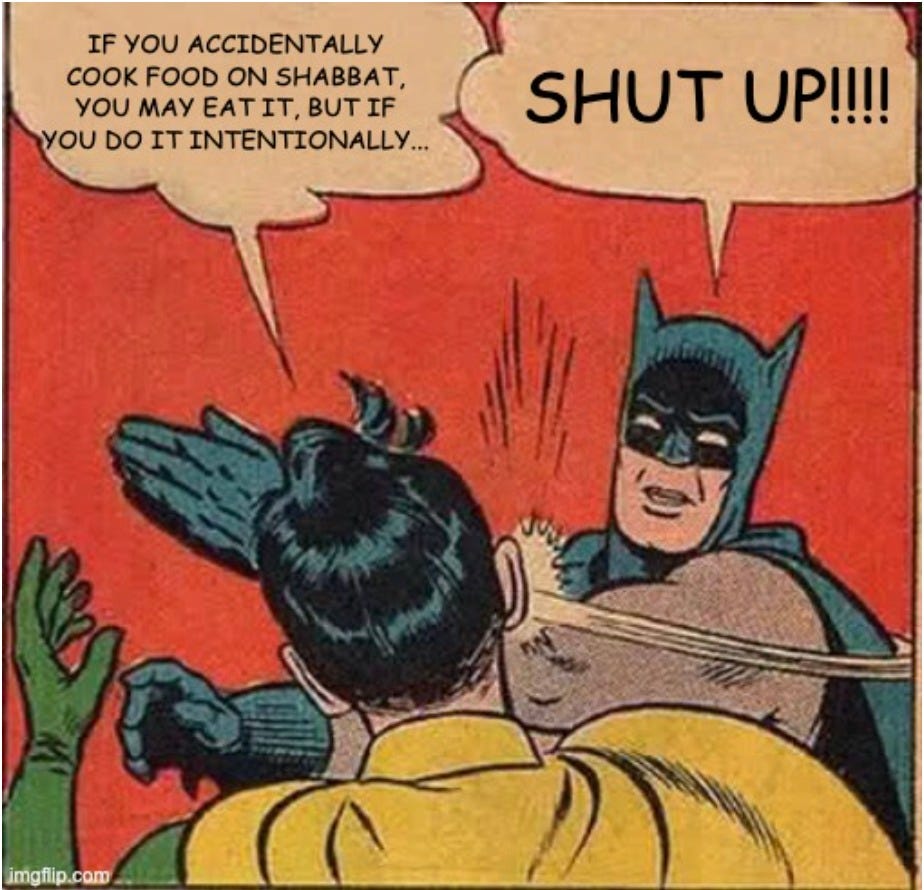
So why would Rav be so rude? One possibility is that he is pissed off because he agrees with Rabbi Yehuda that even an accidental violation fouls the food, and the unfortunate tanna was parroting Rabbi Meir. Still, he shouldn’t have been such a jerk about it. Anyway, as Hanan ben Amei posits, Rav speaks out of both sides of his mouth: publicly, he espouses Rabbi Yehuda’s perspective (to prevent the unlearned masses from becoming careless about Shabbat), but privately, he allows his students to follow Rabbi Meir (כִּי מוֹרִי לְהוּ רַב לְתַלְמִידֵיהּ – מוֹרֵי לְהוּ כְּרַבִּי מֵאִיר, וְכִי דָּרֵישׁ בְּפִירְקָא – דָּרֵישׁ כְּרַבִּי יְהוּדָה, מִשּׁוּם עַמֵּי הָאָרֶץ!). It’s possible, then, that the tanna recited this baraita during a public talk, and Rav didn’t want him to mislead the unwashed masses.
Rav Nachman bar Yitzchak has a different theory: the tanna was actually teaching about slaughter on Shabbat, not cooking (so, what he actually said was that one who slaughters unwittingly may eat; one who does so intentionally may not). Rav corrected him and said: “Nope, Rabbi Meir was only lenient toward accidental cooks, not toward accidental slaughterers, because an unslaughtered animal cannot be eaten before slaughter.” The principle that distinguishes slaughtering from cooking here is the idea that something that is mentally, and practically, “off the table” before Shabbat enters, cannot be used on Shabbat, even in the event of accidental transformation that makes it edible.
The problem with this theory is that there’s a mishna about slaughter on Shabbat, and Rav Huna cites Chiyya bar Rav, who taught in Rav’s name, that eating the meat is forbidden that day. It is implied that this is only Rabbi Yehuda’s strict position, and Rabbi Meir would permit it. But the Gemara says that the dispute between Rabbi Meir and Rabbi Yehuda pertains to a very specific set of circumstances: the presence of a critically ill person in the household before Shabbat. The assumption was that the household butcher was going to slaughter the animal anyway, so as to feed the sick relative, which folds the still-alive animal into the realm of thinkable Shabbat food; Rabbi Yehuda’s more stringent opinion refers to a situation in which the sick person recovered before the slaughter happened, and thus the permitted reason for slaughter is irrelevant.
Okay, so let’s talk about this business of feeding fresh meat to the sick. A healthy relative might think, “well, this fresh chicken we killed to make my brother lifesaving soup won’t come to life anyway, so I might as well partake.” Rav has a clear rule for this: if the meat was slaughtered on Shabbat to feed a sick person, it is forbidden to a health person; however, food accidentally cooked for the sick on Shabbat is permitted. Rav Pappa proposes two exceptions: if the animal was already designated to feed the sick, then it was within the realm of possibility that it would be slaughtered on Shabbat, and then the healthy may partake as well. As to cooking, if it involves cutting a squash off the ground, that’s a separate Shabbat violation, and thus not permitted.
At this point, Rav Dimi introduces the concept of carpaccio: if you slaughtered meat to make soup for the sick relative, the healthy cousin can eat a bit of the raw meat (funny enough, the word for raw meat is umtza, אוּמְצָא, which is the modern Hebrew word for steak). Rav Dimi reasons that, without slaughtering the whole animal, you wouldn’t be able to have even a little bit of meat (tell this to the raccoon who bit our cat last week), and thus it’s a waste for it to not be eaten. By contrast, with cooked food, the concern is that if there’s a beeline of healthy people waiting to eat the soup or stew, the cook could be tempted to increase the amount they cook, thus leading to a slippery slope of Shabbat violations.