

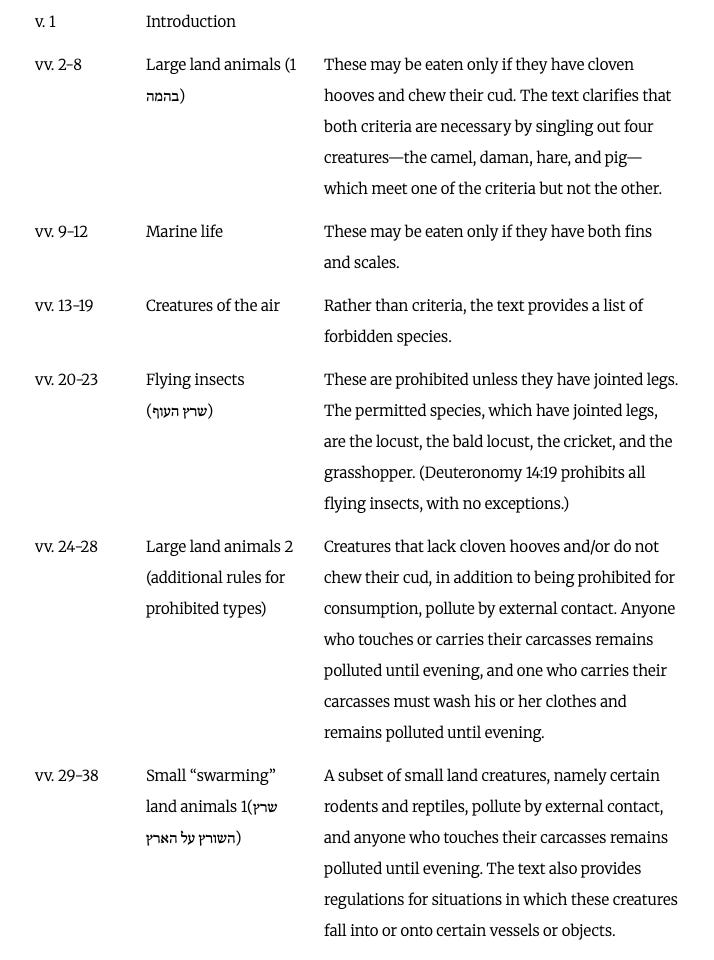
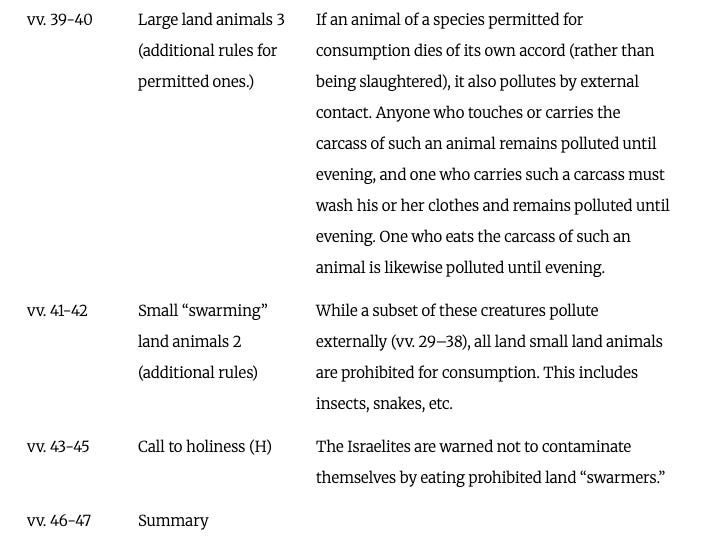
We pause our oven stories series to fold in a sweet zoology moment from today’s page (I promise we’ll get to Manichaeism soon!). Our tractate has turned to issues of kashrut and defilement. For a great overview of biblical dietary laws, see Eva Levavi Feinstein’s article about purity. The basics appear in their final form in Leviticus 11, and here’s the schematic that Levavi Feinstein provides in her article:
The descriptor “on the land” raises questions about animals who live in other habitats. A baraita states that rats and mouses are both impure, but what about a sea mouse, which was also called at the time “mouse”? Rashi explains that a sea mouse is a fish. I found this species, Aphrodita Aculeata, which is known as “sea mouse” in English, and they speculate that it was named so because it looks like a bedraggled mouse when washed ashore. The Talmud considers this animal, or something like it, and offers three paths: (1) the impurity is related to land, because Lev. says “on land”; (2) anything named “mouse” is impure, whether on sea or on land; or (3) regardless of the animal’s classification, if it happens to go sailing or swimming, it does not impart impurity, and if it washes ashore, it does.
Continuing on the theme of land animals, we learn of salamanders and something called nefilim, and apropos this list, Rabbi Akiva marvels:
“How great are Your works, O Lord” (Psalms 104:24). You have creatures that grow in the sea and you have creatures that grow on land. If those in the sea would ascend to the land they would immediately die. If those that are on land would descend to the sea they would immediately die. Similarly, you have creatures that grow in the fire and you have creatures that grow in the air. If those in the fire would ascend to the air they would immediately die. If those in the air would descend to the fire they would immediately die. Therefore, “how great are Your works, O Lord.”
Isn’t this fabulous?
Then we have the creation of a new species. The Talmud mentions an animal called an arvad, which Rashi explains “comes from a turtle and a lizard/turtle.” It’s unclear what this thing is, but there’s a cool story about how it came about: Rav Huna tells that, in the city of Va’ad, the locals tried to breed a snake and a lizard/turtle, and the arvad emerged from that. Simon the Righteous explained that God brought forth the arvad, saying: “these folks produced a creature that I did not create in My world; so too, I will bring upon them a creature that I did not create in My world.”
Was cross-breeding animals a thing in those days? Mar says that animals can breed if their method of procreation and gestation (תַּשְׁמִישָׁן וְעִיבּוּרָן) is the same, so the emergence of the arvad was a miracle. This reminded me right away of Darwin’s finches:
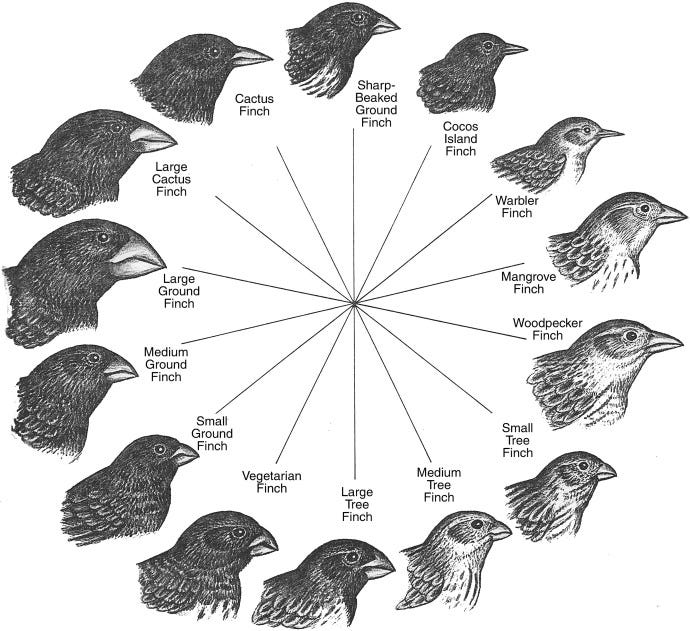
Darwin found 13 species of finches in the Galápagos islands (and an additional species outside the islands). The finches all share a common ancestor and have similar nest architecture, egg pattern, and courtship displays, but they differ in song, morphology, and plumage.
Per this cool article in Science Direct, Grant (1986) proposed a three-step process to speciation to explain the adaptive radiation of the group:
(i) The ancestral species arrives in the archipelago; (ii) the species spreads to other islands and as a result of this, there will probably be some selection and hence differentiation in size because the islands are different; and (iii) members of the original and derived populations encounter each other, and as a result of competition for food and selection against intermediates character displacement causes rapid divergence in feeding structures between the species when they come together.
Could it be that this Talmudic passage about cross-breeding is some early insight into the possibility of evolution?