

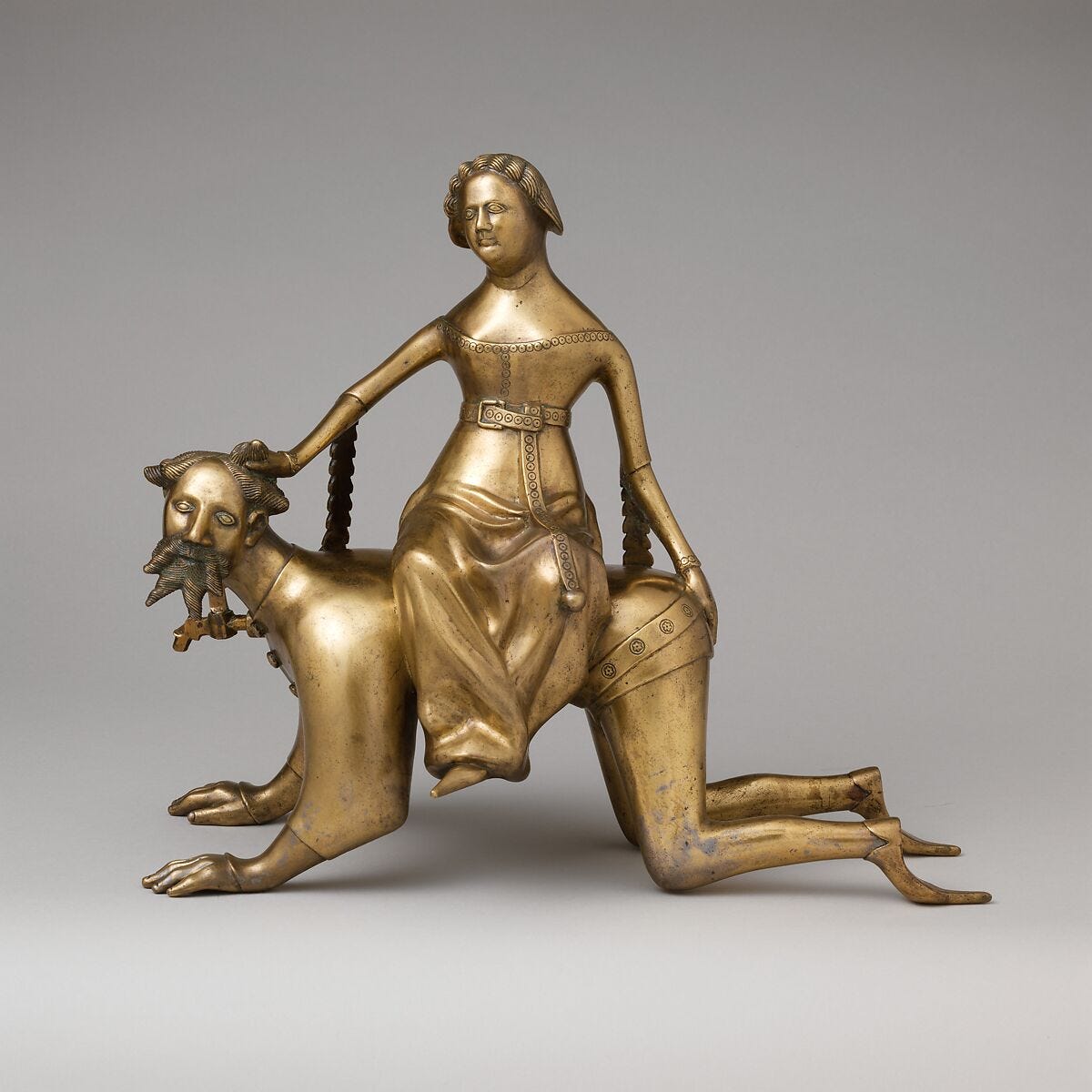
We left things off with a pretty saucy story about Rabbi Eliezer and some indications that sexual promiscuity and sex work were going to be discussed, and today’s page does not disappoint: it’s full of salacious stories, and while the link is not made explicitly, it’s pretty clear that the seduction/temptation of loose sexuality is analogized to the seductive nature of heresy.
The opening gambit is a double punch from Proverbs. First, Proverbs 30:15: “The leech has two daughters: ‘Give, give.’” Mar Ukva says these are two daughters crying out from hell, and in this world they ask, “give, give,” asking for heresy. Or, perhaps he said that it is the very voice of hell crying out: “Bring me two daughters who scream and say, “give, give.”
Then, Proverbs 2:19: “All who go to her shall not return, nor will they attain paths of life.” Which raises the question - if they do not return, why is it necessary to specify that they will not attain paths of life? The Gemara thinks it’s to ensure that one knows that, even in the off-chance that they shall return, they will not attain paths of life. The “her” from the verse is interpreted as heresy, and the Gemara then raises a theodicy question. If everyone involved in heresy died, what about this woman who confessed a horrible sexual transgression to Rav Hisda and said, “this is the least of my offenses,” and nevertheless lived on? And how was she different than a similar woman, who did die?
The Gemara tells the story of Rabbi El’azar ben Durdaya, who sought prostitutes wherever he went. Once he heard of a prostitute who lived overseas who took a pouch of dinarim as wages. He. crossed seven rivers to see her, and when they got to business, she passed wind. Then, she said: “the same way that the fart can never return into my body, Rabbi El’azar can never be forgiven for his sins.” He sat between mountains and hills and said: “Mountains and hills, ask mercy for me!” The mountains and hills said, “if we’re going to ask anything, it’ll be for mercy for us.” He asked heaven and earth to ask for mercy for him, and they similarly declined, as did the sun and the moon. Then, he realized that his repentance is only up to him: he lowered his head between his knees and sobbed until he died, and then a voice proclaimed that he would get an afterlife - despite his sins being so bad that they could be considered heresy.
Rabbi Yehuda Ha-Nasi cried when he heard this story: not only was this man able to roll back his life of transgressions, but also to be referred to as “Rabbi” (which I think raises some contemporary issues about transgressive people retaining their merit and honorifics even after their deeds are exposed.)
Another story: Rabbi Hanina and Rabbi Yonatan came to a fork on the road. One path led to idolatry and one to a brothel. On said to the other, “let’s go on the idolatry path, because we’ve conquered our desire to do that, while we don’t handle our sexual appetites very well.” The other answered: “Then let’s go by the brothel and conquer our desire!” And when they got there, the considerate prostitutes, not wanting to corrupt the men, stepped inside the brothel. The men thought that the women retreated out of embarrassment. What’s interesting is that the proverb they quoted to support this, Proverbs 2:11 (“מְזִמָּה תִּשְׁמֹר עָלֶיךָ תְּבוּנָה תִנְצְרֶכָּה”), can be read in two ways: conventionally, it praises being strategic (mezimma, scheme), but they read it as referring to salvation from lewdness (mi-zimma, from lewdness).
Then we turn to a story about Rabbi Eliezer ben Parta and Rabbi Hanina ben Tradyon, who got caught by the Romans. Rabbi Eliezer said: “You’re lucky they charged you only with one thing; I got charged with five.” Rabbi Hanina answered. “Nah, you’re lucky you got charged with five things, but will come out of it okay; I got charged with only one thing and won’t be saved, because you studied Torah and did charity, and I only studied Torah.” Rav Huna interjects: he who only studies Torah is as a godless person. Thing is, Rabbi Hanina was actually in charge of distributing charity, and did so with integrity, but he did not collect or contribute to the charity himself. Once, he confused his own coins, with which he was going to purchase Purim treats, with charity monies, and ended up distributing them to the poor, but that is apparently insufficient.
The time came for the trials of the two men. Rabbi Eliezer came up first, and the Romans asked him: why did you teach Torah, and why did you steal? He replied: “He who is a scholar cannot be a thief” (אִי סַיָּיפָא לָא סָפְרָא, וְאִי סָפְרָא לָא סַיָּיפָא), implying that he was neither a scholar nor a thief.
Let’s pause here for a moment, because I find this an interesting insight about the burden proof. Assume that Dude is accused of two mutually exclusive crimes:
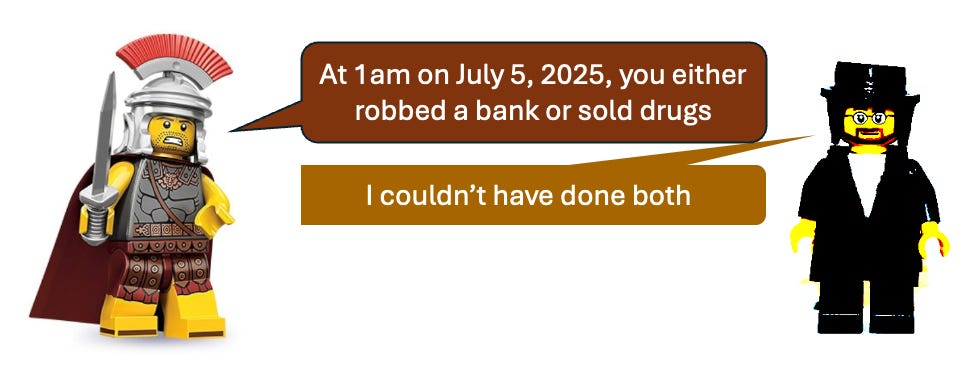
If the legal system requires proof beyond reasonable doubt to convict, in this situation our defendant cannot be convicted of either. Might be easier to understand why if you consider the following example:
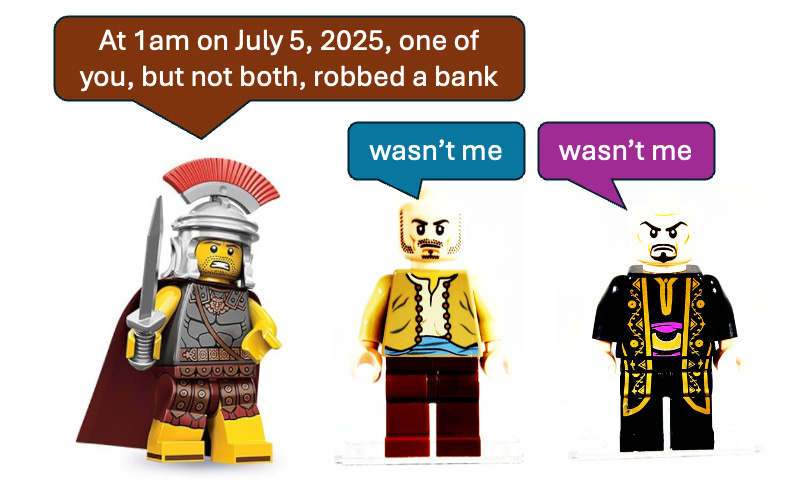
Of course, for Rabbi El’azar to prevail on his claim, the Romans would have to buy that scholars and thieves are two mutually exclusive categories (tell that to a plagiarist!). Anyway, the Romans asked him, “if you don’t teach Torah, why do they call you Rabbi?” He replied: “I teach weaving.” They asked him about some specific weaving terms, to see if he knew anything about weaving—which thread was the warp, which is attached to the loom, and which is the woof, which weaves in and out of the warp. He didn’t know the answer, because he wasn’t actually a weaver, but then, a miracle occurred (אִיתְרְחִישׁ לֵיהּ נִיסָּא): a female hornet sat on the warp and a male hornet on the woof, and that’s how he knew which was which.
The Romans then asked Rabbi El’azar why he did not come to a gathering at Beit Avidan; he explained that he was worried about getting trampled because the place was crowded. “But how many elders were trampled there?” they asked. And then, a miracle occurred: an elder was trampled that very day (not much of a miracle for that elder, I’d say).
Then, they asked Rabbi Eliezer why he emancipated his slave, which he denied. A prosecution witness rose to speak, but then the prophet Elijah, disguised as a Roman nobleman, whispered on the witness’ ear: “You know there’ve been miracles every time he got accused of something; you’d better not testify.” The witness ignored Elijah and rose to speak. Elijah reached into his pocket and found an important letter written by Roman dignitaries to the Emperior, which was entrusted to the witness, and threw the letter far away; the witness left to fetch it and never returned, and Rabbi El’azar was acquitted.
Then, it was time for Rabbi Hanina’s trial. The Romans asked him, “why did you study Torah?” Rabbi Hanina (unwisely?) replied, “because my God ordered me to.” So, they sentenced him to die by burning (the Gemara theorizes, because he uttered God’s ineffable name); they also ordered that his wife be executed (for not preventing him to utter the name, the Gemara explains) and his daughter relegated to a brothel. Far more cheerful about this than you’d expect, Rabbi Hanina and his family members went their way citing biblical verses.