

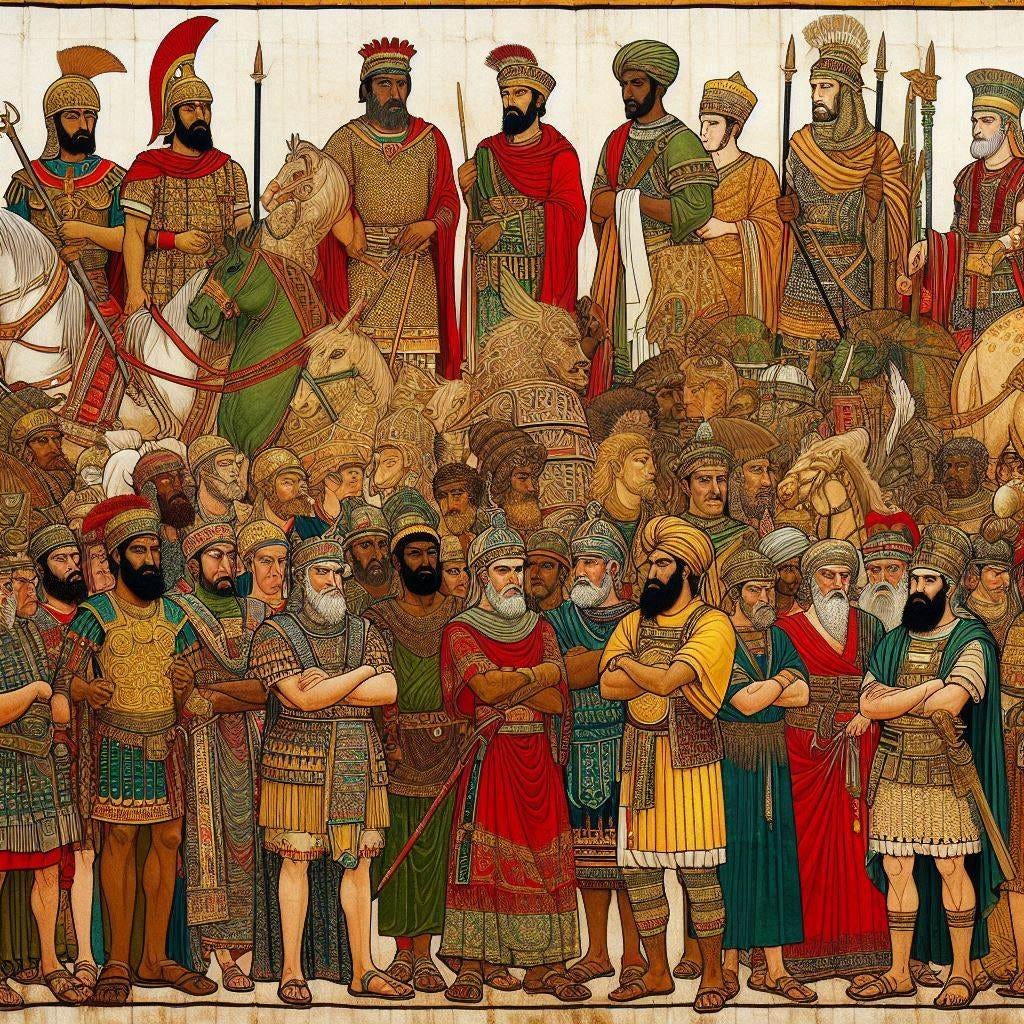
Welcome to our new tractate, Avodah Zarah (literally, “foreign work,” meaning worship by gentiles)! This one is going to be quite different from the previous ones we have studied together—it is juicier and quite a bit more provocative.
As I explained in the video yesterday, Avodah Zarah is full of stories. Some of the stories are fantastically universal and ecumenical and some are shockingly xenophobic. In essence, these stories all go to the heart of the complicated question: what sort of relationship should Jews have with their non-Jewish surroundings? There are some Mishnaic rules, but these mostly serve as excuses for long rounds of rich storytelling.
Many of these vignettes come off as a Jewish supremacy power trip, but the idea that there’s any bite behind the bark is, at this point, misguided. The Mishna was written and edited against the backdrop of the fall of the Temple and the failure of the Bark Kokhva rebellion, but it the rules in it hew close to the Biblical rules and are in complete denial of the collapse around it (David Kraemer’s superb book provides a great intro to this issue). But by the time the Babylonian Talmud was being edited, the denial was impossible; the rabbis, which appear to be supreme and influential authorities, were still trying to establish their authority among a people defeated, exiled, and persecuted, and likely did not have authority beyond their own disciples, at least in the first few generations. The synagogue and study hall were still far from the consensually accepted default mode of Jewish engagement. What they had to say about Jewish-Gentile relations probably bore very little connection to the realities of these relationships among the many Jews in exile who were not part of these circles—still discombobulated from the loss of Temple-centered Judaism and not yet on board with the text-based form Judaism would then take.
That said, the fantastical style of this tractate belies many practical everyday problems: like me, and like some of the people learning along, these Jews lived in a cultural milieu in which they were not the majority or even a particularly dominant subgroup. There is quite a bit of this to which I can relate. Arriving in the United States in 2001 and seeing no public representation of any of my major holidays—cars around on Yom Kippur, nothing festive on Passover, no costumes on Purim (beyond the usual Berkeley garb and coiffure, that is)—was intellectually comprehensible, but a visceral shock to the system. My partner had a similar shock during the two years that we lived in Israel when he found little evidence of the Christmas hoopla he was used to from predominantly Christian countries.
Not all exile is the same, of course. Three years ago, my son made a convincing argument that we should go somewhere snowy in winter (lest all his children’s books about the snow be deceiving us about the season), so we went to New York. I marveled at the public displays of Hanukkah: hanukkiot and sufganiyot and levivot everywhere. It’s not exactly my Judaism—the Manhattan Jew, albeit emblematic, is not the representation of every Jew in the United States, let alone the planet—but it was definitely there, and a good reminder of how little my own culture is publicly celebrated where I live.
When I read the Avodah Zarah stories, therefore, I read them through the lens of a Jew adapting to a reality in which he or she are surrounded by a culture that is not welcoming, affirming, or even comfortable, for Jews. They cope with business on Shabbat, with icons, with transactional and personal relationships that follow different ethical codes, with cultural cues they find alien or even offensive. Regardless of whether any slights are intended or not, the foreignness of the environment is palpable. And the Talmudic language, which bristles and patronizes and cackles in schadenfreude belies the confusion, loneliness, and pain of being away from one’s land.
I am also keenly aware that we are studying this tractate at an exceptionally complicated time for Jews and for many other people. Usually, I’m not a fan of trigger warnings, preambles, preemptive non-apology apologies, etc., but the sensitivity and volatility of the moment require special caution. So: recounting xenophobic stories from the Talmud is not endorsing them. It’s not even suggesting that most or even a significant subset of Jews still subscribe to these views (more than a handful, unfortunately, still do). It’s not a presentist effort to clothe current grievances in historical garb to score points or for ironic effect. I’m just following the train of thought of people who thought and wrote these things 1500 years ago, because this is my cultural heritage, and like everyone else on the planet, if I am to live an examined life, I need to face it.
Anyway, that’s it. Shall we get to business?
The opening Mishna does not pull punches: for the three days before a foreign holiday (“eideihen” - אֵידֵיהֶן, from the Semitic word for holiday, preserved in the Arabic eid), do not engage in transactions with them (presumably because that’ll make them happy). Rabbi Yehuda throws in an extra barb: you can collect debts from them, as it’ll make them sad. The others reply: well, yeah, but later they’ll be relieved to have paid off the debt. Rav and Shmuel then adhere to different spellings of the word “eideihen”: with an alef at the beginning (implying trouble), and with an ayin at the beginning (implying witnesses). This last interpretation, folks, is going to be the punchline of the following story:
Sometime in the future, God sits down with a Torah scroll in his lap and says, “whoever has studied it, come forth and get your reward.” All the peoples of the world come along, and God orders them to come in one by one.
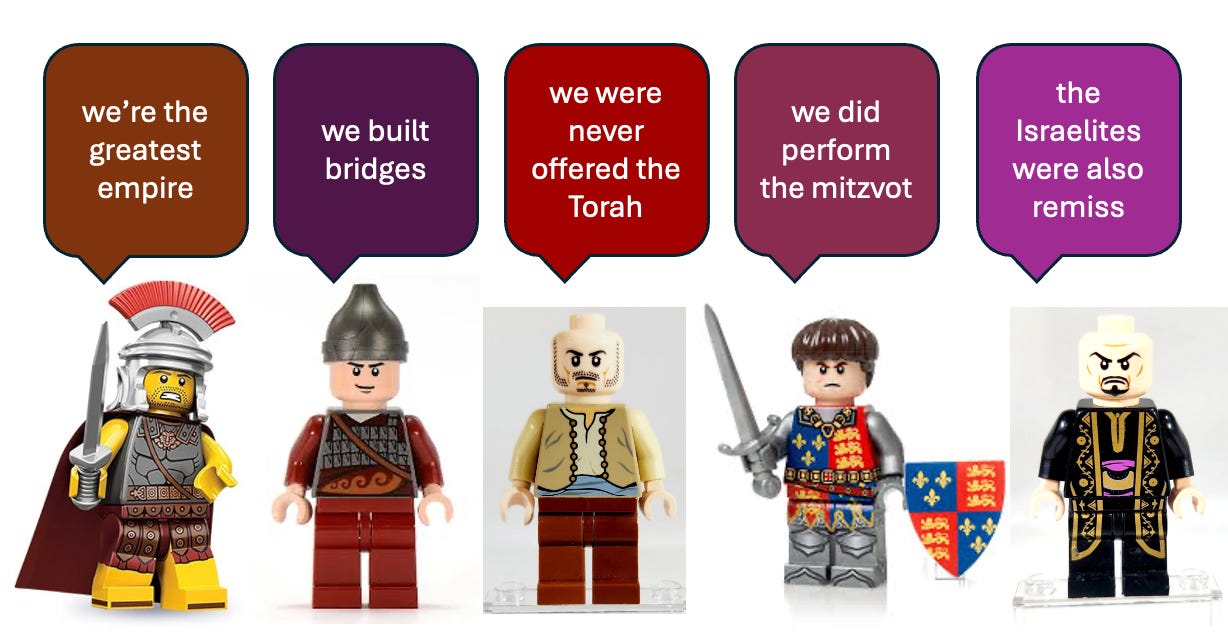
First enters Rome (the rabbis comment: the most important and the most wicked), boasting: “we built markets, baths, riches, all this so that the People of Israel can study Torah.” God scolds them: “You fools! What have the Romans ever done for us? All you’ve done you did for yourselves: markets for prostitutes, bathhouses for your own grooming, and the riches are all mine.” Rome leaves dejected.
Persia enters second (Daniel 7:5 reads “second, like a bear,” so Rav Yosef says, they eat and drink like bears, and are pudgy, hairy, and restless like bears). Even though they see Rome leaving, they come in, thinking that their building the temple (and Rome destroying it) will work in their favor. They boast building bridges, conquering cities, fighting wars, all so that Israel can study Torah. God is not impressed: “All you’ve done you did for yourselves: bridges to take tolls on, cities to enslave, and the wars are all mine.” Persia also leaves dejected.
The rest of the nations also come in, thinking they’ll fare better because, as opposed to Rome and Persia, they did not enslave the Israelites (אֲנַן לָא שַׁעְבַּדְנוּ בְּיִשְׂרָאֵל). They raise a reasonable argument: “You never gave us the Torah, how could we have studied it?” The story cites several verses on the giving of the Torah: “God came from Sinai. . . rose from Seir” (Deuteronomy 33:2), and “God shall come from Yemen. . . from Mount Paran” (Habakkuk 3:3), and Rabbi Yohanan theorizes that God tried offering the Torah to all these nations and they did not accept it (Israel was the last on the list).
The nations complain that God was not as invested in giving them the Torah, but rather foisted it on Israel. God asks them, “fine. If so, did you comply with the Noahide Obligations?” (see Sanhedrin 57 onward). Rav Yosef deduces from Habbakuk 3:6 (“makes the nations tremble”) that the nations were remiss, so God relented and canceled the obligations. Mar, Ravina’s son, adds that one should not get rewarded for following the Noahide commandments (to be fair, those are a pretty low bar for human behavior). But the nations retort that the Israelites have also been remiss in following their commandments. God says, “I attest that they have followed the entire Torah.” The nations say: “You’re biased.” God says, “fine, then Heaven and Earth will attest.” The nations don’t buy this either: “Heaven and Earth are also biased.” [Here, Resh Lakish interjects: God told Creation that, should Israel not follow his commandments, he’ll return the world to chaos.]
God pulls a classic courtroom trick: he puts the nations themselves on the witness stand as hostile witnesses. “May Nimrod attest to Abraham’s monotheism! May Laban attest to Jacob’s honesty! May Potiphar’s wife attest to Joseph’s innocence! May Nebuchadnezzar attest that Hananyah, Mishael and Azaryah did not bow to the idol! May Darius attest that Daniel was pious! May Job’s friends attest to Israel’s piousness!” So, the story comes full circle, and “eideihem” could mean “witnesses.”
The nations tell God, “fine, give us the mitzvot and we’ll do them!” God says, “you fools, that ship has sailed. But here, do this easy and cheap one: build a sukkah.” They all go and build sukkot in the summer, and God heats up the weather, and they’re all miserable and run back to their air conditioned McMansions. [Lest you think God is being unfair here, the Talmud reminds us that the heat of the summer does last sometimes until the High Holidays.] God sits up in heaven and laughs (and, to add insult to injury, Rabbi Yitzhak says that God never laughed except on that day).
We then get a more extreme version of the story: all nations of the world convert to Judaism, complete with tefillin, tzitzit, mezuzot, all the trappings, until they see the apocalyptic Gog and Magog war heating up, and then they drop all that and head home, leaving God laughing in the heaven.
All this talk about God laughing raises the question how he passes his time in the heaven. Rav provides the following daily agenda for him:
Hours 1-3: God studies Torah.
Hours 4-6: God judges the world, and when he finds the world on the brink of destruction, he moves from the Seat of Justice to the Seat of Mercy.
Hours 7-9: God feeds the whole world, from buffalo to nits.
Hours 10-12: God plays with his pet, the leviathan.
Rav Aha begs to differ: since the destruction of the Temple, God doesn’t have fun or laugh, not even with his pet. Instead, on Hours 10-12 he teaches Torah to little kids. Before the destruction, Metatron taught the kids. Or, perhaps, God used to multitask - playing with the leviathan while teaching the kids.
At night, God does the same stuff he does during the day; or, if you will, he rides a light Cherub across the 18,000 worlds, or hears animals recite poetry.
Stay tuned for page 4!