

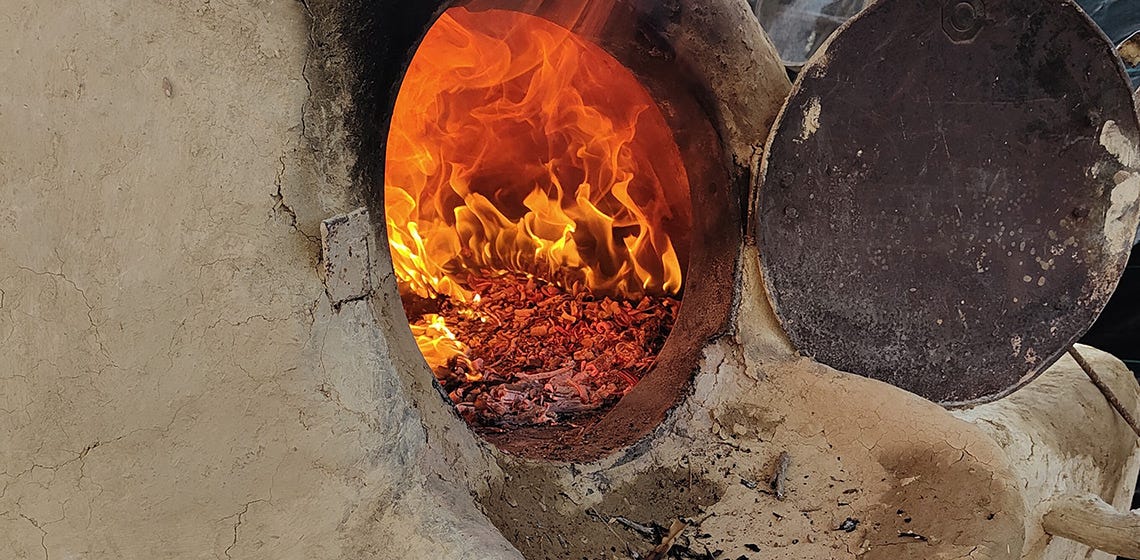
The five oven stories we’ve reviewed (Rabbi Tzadok and the Matronitha; Rabbi Hiyya bar Ashei and the fake courtesan Herutha; The Ukvas and the Panhandler; Shorty Singed-Shins; and Rabbi Prida’s Grandpa’s Wife and the Skull of King Jehoiakim) are, as we’ve seen, meditations on shame, envy, and performative piety. The unusual inclusion of the oven detail might indicate, though, something beyond these earthly issues. This is hinted in the coda to the third story, about Mar Ukva:
אָמְרִי לָהּ אָמַר רַבִּי יוֹחָנָן מִשּׁוּם רַבִּי שִׁמְעוֹן בֶּן יוֹחַי: נוֹחַ לוֹ לָאָדָם שֶׁיִּמְסוֹר עַצְמוֹ לְתוֹךְ כִּבְשַׁן הָאֵשׁ, וְאַל יַלְבִּין פְּנֵי חֲבֵרוֹ בָּרַבִּים
On its face, this is a laudatory comment for Mar Ukva’s behavior: he opted to literally give himself into the fire of the oven, in to which he fled rather than shame the pauper he supported by having his beneficiary see his face. As we’ve already seen, a careful reading of this story complicates this facile moral, because Mar Ukva’s secret donations and evasive maneuvers are not as righteous as his wife’s straightforward household assistance. But the way the coda is formulated suggests that the story was formed to take a hyperbolic maxim (“better to burn in hell than—-”) and stage it literally. We see Rabbi Tzadok, Rabbi Hiyya and Rabbi Zeira enact the metaphoric fires of Gehenna with the common household prop that is the closest representation of Gehenna: a lit oven.
The idea that we are offering ourselves a preview of hell from the privacy of our home or courtyard is especially salient in the first story, where Rabbi Tzadok tells the Mathronita: “whoever does this, falls into this.” Rather than tell her, “I can’t sleep with you, I’ll go to hell for it,” he has physically performed, before her very eyes, the symbolic dangers of acceding to her seductive powers. It is also salient in the fourth story, where Rabbi Zeira’s excessive fasting is explicitly for the purpose דְּלָא נִשְׁלוֹט בֵּיהּ נוּרָא דְגֵיהִנָּם, that he shall not be vulnerable to the fires of Gehenna—and his ascetic shin-singeing practices are explicitly designed as a monthly test of his durability in the afterlife (כֹּל תְּלָתִין יוֹמֵי הֲוָה בָּדֵיק נַפְשֵׁיהּ).
The Gehenna element is perhaps less explicit, but still palpable, in the second and fifth stories. In the second story, Rabbi Hiyya has not technically committed the sin, but his self-punishment (which is also, as we discussed, incredibly self-centered and compounds the deep insult to his wife) flags how he sees his own depraved intent. And in the fifth story, even though the wife’s incineration of the skull is presented as a narrowminded act of jealous rage, we (the readers) know that the skull is that of King Jehoiakim and thus witness the fulfillment of the double prophecy: a bad death and a shameful afterlife.
In short, the oven fire in our stories functions as an immediate, embodied stand-in for the fires of Gehenna, and since these Bavli stories have no parallel in the Yerushalmi, that raises the question: is there a difference between the perceptions of the afterlife in the two Talmudim?
In yesterday’s post I pointed out some of the internal and geopolitical reasons for the untimely redaction of the Yerushalmi, and how this resulted in a terser text than that of the Bavli. Scholarship about the Talmudic composition increasingly flags the immense impact and importance of the final redactors of the Bavli, the stammaim, on its final coverage and style (several Talmud commentators have change their minds on this and ascribed more importance to the final stages than was previously thought). As Adiel Schremmer explains, the Bavli’s “early sources were not only compiled, but also interpreted, augmented and reformulated” to the point that “we should assign. . . sources found in the Bavli as Tannaitic and Amoraic. . . to the Stammaim. . . and view them as revealing Stammaitic interests and concerns.”
If so, the presence of the oven stories in the Bavli, rather than the Yerushalmi, is not so much an issue of competing theologies about the afterlife, but rather the product of the more developed literary elaboration of the afterlife in the Bavli. When we studied Tractate Sanhedrin, we covered an entire chapter going in depth into who does and does not get an afterlife (also see Alan Segal’s Life After Death to show how much this fleshes out the matter compared to the original mishnayot, and how it differs from contemporary Christian discussion of the afterlife).
I should pause for a moment and acknowledge that, in most progressive Jewish denominations, people have deep uneasiness with the idea of the afterlife, and I wish I had a penny for every pat version of “Jews are more concerned with being good in this life rather than on the rewards of the next” that I heard from congregants who were told this by garden-variety rabbis with little intellectual curiosity. This is shallow and incomplete, but not completely false: there are definitely Talmudic anecdotes that support this approach, which Simcha Raphael identifies in his book Jewish Views of the Afterlife. Raphael reminds us that Shimon bar Yohai and his son were purportedly punished—sentenced to a year of penance in a cave!—for sneering at a man plowing a field and exclaimed, “They forsake life eternal and engage in life temporal” (b.Shabbat 33b). Similarly, b.Shabbat 30b tells of King Solomon asking the Beit Midrash sages: “My father is dead and lying in the sun; and the dogs of my father’s house are hungry, what shall I do?” They sent back this answer: “Feed the dogs first and then attend to your dead father . . . living dogs take precedence over a dead king.”
At the same time, the Bavli has a lot of vivid detail to offer about what happens in the next world. b.Berakhot 57b offers a comparison between regular fires and Gehenna fires: “Our fire is one-sixtieth of the fire of Gehenna” (suggesting that Rabbi Zeira’s experiment, even if successful, would not have positively indicated that he was inured to the fires of hell). b.P’sahim 54a tells us of the creation of Gehenna (on Shabbat eve!). b.Rosh HaShanah 16b describes the massive descent into Gehenna. Numerous places, including b.BM 58b, b.Berakhot 10a, b.Hagiga 15b, and b.Megillah 14a, tell of who is and is not going to Gehenna—including, at least in the latter place, a description of particular departments in there reserved for Korah and other classic baddies. Importantly, as Yuval Fraenkel reminds us, “the term ‘olam ha-ba frequently functions within a distinctly eschatological context [which] links the world of the dead with the new age that will take place in the end times.” At the same time, Fraenkel flags numerous places where we get glimpses into “strikingly mundane” visions of the afterlife: “Sarah, who plucks lice from Abraham’s hair in their shared grave (b.BB 58a); Elijah, who wakes the three patriarchs, washes their hands, and puts them back to sleep (b.BM 88b); a sage who growls at a clay digger disturbing his grave’s tranquility and another who leaps from his grave to seize a Zoroastrian priest’s beard (b.Shabbat 158b); a sage who steals the Angel of Death’s knife and jumps over the fence of the world of the dead (b.Ketubot 77b) and yet another, whose body has remained in an attic for twenty years, still engaged in halakhic deliberation (b.BM 84b); two spirits converse in a cemetery (b.Berakhot 18b); and so on.”
The Angel of Death also makes some appearances, showing up in both Talmudim but mostly in the Bavli (b.Avodah Zarah 35b; b.Yoma 77b; b.Sukkah 53a), where he plays a bit of a straight man to the sages’ jokes, sometimes bargaining with them and sometimes outwitted by them.
Why is it, then, that the Yerushalmi spends less time on these mechanics and visuals of the afterlife? This goes back to some of the comparative context we’ve already covered, most specifically the Sasanian-Zoroastrian context. As both Yaakov Elman and Shai Secunda have flagged in their work, and as we discussed in our brief post about this, Zoroastrianism in this period had an extremely developed eschatology, which included individual postmortem judgment, a highly specific geography of reward and punishment, and bodily resurrection as a cosmic doctrine. As we explained, by contrast to the conventional approach of early Talmud scholars that saw the rabbis as isolated, Secunda and many others argue that the Bavli’s rabbis, who had lived alongside their Zoroastrian neighbors for centuries (and, importantly, the redactors!) absorbed Zoroastrian ideas about the afterlife, which differed from the Roman and Christianizing atmosphere that surrounded the Yerushalmi. Importantly, as Alan Segal explains, Christian views of the afterlife evolved considerably after the Yerushalmi had already been redacted.
This, as well as the Bavli’s stylistic elaborations and literality, can explain why the oven stories do not have parallels in the Yerushalmi. But it’s now occurred to me that the Bavli’s greater elaboration of home life, and its inclusion of narratives with women protagonists (Gail Labovitz calls them “guerilla girls”) might also explain why we get stories that have a strong domestic focus and prominent female protagonists in the Bavli that are missing from the Yerushalmi.
This, I think, brings to a close my inquiries about the oven stories. I may get back to this in the future, but I think I’ll go back to Tractate Hullin so we can stay on the universal timeline. People have been texting me about how much they like these, and I’m so grateful for your interest in this weird and creepy little detour!