

Holy Moly, we are so behind. In my defense, I was actually studying Talmud - just not the relevant pages. One of my courses this spring is on tzedakah - righteousness, almsgiving, charity - from the Bible to the Bavli, and we had a hefty assignment that required parsing out several pages of the Yerushalmi, which is written in much more gnarly Aramaic than the elegant one in the Bavli. Along the way, I got sucked into a story I didn’t know about two of my favorite Talmudic characters, Yohanan and Resh Lakish, and started thinking about a project in which I want to look at the earlier stories about these two. In any case, all that was a lot more engaging than the recent few dapim, which are all about idolatry. But let’s see what treasures we might dig as we get up to date!
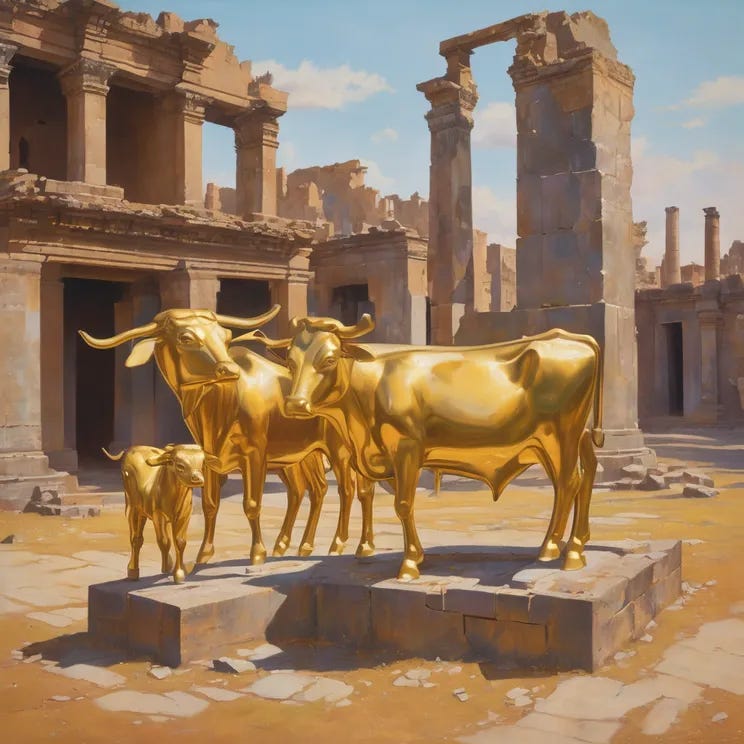
These pages return to a topic that was brought up earlier in this sugiyah: the stories of the three bad kings who will not receive an afterlife, i.e., Jeroboam, Ahab, and Menasheh. Page 102 goes in depth into the traumatic severance of the kingdom, in which prophet Ahia the Shilonite tears his cloth in two. The sages believe it was foretold and provide some biblical anchorings. The metaphors for the rupture are very powerful: if, says Rabbi Oshaya, Israel would suckle from one calf before the severance, afterwards they would suckle from two or even three calves. Rabbi Hanina also believes that the golden calf incident foretold the severance of the kingdom 24 generations later. Jeroboam was so bad, says Rabbi Abba, that, when God told him, “hey, repent and then you and I and David can take a stroll in the Garden of Eden,” he asked, “who will walk first?” God said, “David will walk first,” and Jeroboam said, “then I’m not coming.” (rimshot!)
Rabbi Abbahu was supposed to lecture about the three bad kings and got sick, canceling the lecture. When he felt better, he decided to lecture about them anyway. His students said, “but you told us that you canceled.” Rabbi Abbahu said, “why, did they repent while I was sick?” (rimshot!)
Rabbi Ashi was also supposed to lecture about the three kings and announced that the next day they would discuss “our colleagues.” But at night, King Menashe came to haunt him, which is way worse than a nightly visit from Hamlet’s father. Menashe complained that Ashi referred to him as a colleague, pointing out that he had taught many things that the sages followed. “What about the idolatry business?” asked Rav Ashi. “Did you teach us that, too?” “Had you been there, you’d have followed me into idolatry,” explained Menashe. The following morning, perhaps trying to avoid another spooky visitation, Ashi said to his students, “today, we will discuss our teachers, the three bad kings.” (rimshot!)
Part of the problem with the three kings stuff is that they were, after all, kings, and therefore did not seem to be punished for their own misdeeds. Ahab was followed by the elders (the gemara explains: they were evil elders) and by the people (the gemara clarifies: not all the people, only the evil ones.) But some of the sages illustrate that Ahab was a complicated man with some redeeming features: some respect for Torah, some philanthropy, and some balance of temperament. As to Menashe, the sages point out that depriving him of an afterlife is a disincentive to penitents. Moreover, God did consider resetting the slate for Israel a couple of times, but Yehoyakim and Tzedekiah were such bad kings that he reconsidered.
This is followed by a few neat zingers:
From Rav Hisda, who quotes Rav Yirmiyah: there are four groups who won’t get to welcome the Shekhinah: כַּת לֵצִים, כַּת שַׁקְרָנִים, כַּת חֲנֵיפִים, כַּת מְסַפְּרֵי לָשׁוֹן הָרָע - jokers, liars, brownnosers, and gossips.
From Resh Lakish: the letter “ayin” in the word רשע (“rasha”, evil) hangs upward, because without it, the person who is poor (presumably in good attributes, רש) below will become poor (רש) above as well.
After this, the sages consider a whole sequence of other bad biblical protagonists and why they had not been included in the no-afterlife list. Sometimes, when the father or son of the bad king was actually a righteous ruler, the bad king got a pass for their sake.
We end this installment with a gemara story. Two men were taken captive on Mount Carmel, and their captor was walking behind them. One of the captives said to the other: the camel who walks ahead of us is blind in one eye and carries two wineskins, one with wine and one with oil, and the two men who are driving the camel, one of them is an Israelite and the other is not. The captor scolded them: “You stubborn folks, how do you know all this?” They replied: “We figured out the camel was blind because it only ate grass on one side of the road and we noticed that the grass on the other side was uneaten. We surmised the content of the wineskins because they both drip, but while the wine is absorbed in the ground, the oil floats on it. And we guessed about the people driving the camel from the fact that one defecated on the road while the other left to the side and hid behind a bush.” I’ll let you guys guess which was which. In any case, the captor, intrigued, went to investigate, found out they were right, threw a huge party in their honor, danced for them, and set them free. At least in Bavli land—all’s well that ends well.